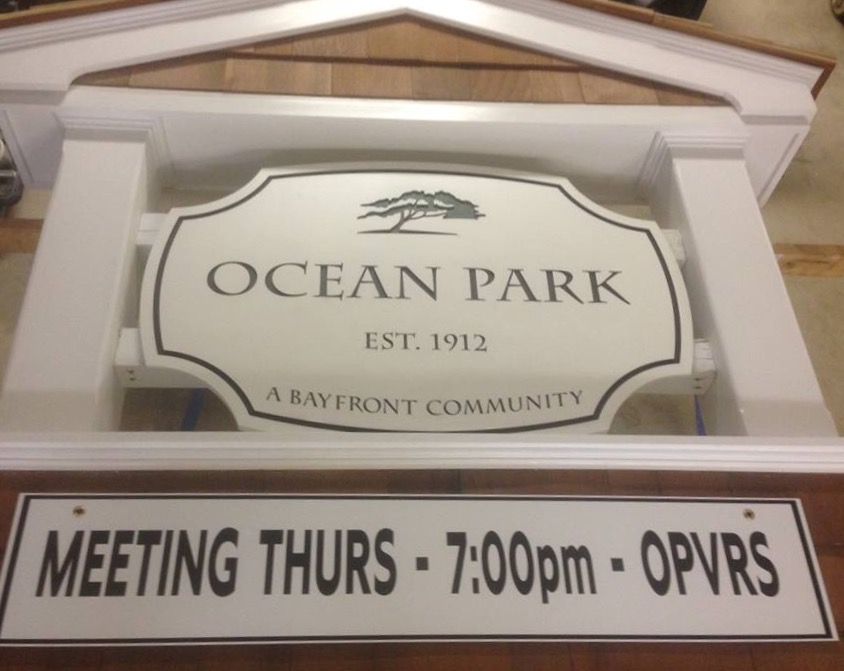
Join us 💥tonight Thursday, June 5th at OPVRS🚑 or also on ZOOM! ( NOT at Brock.. see you at the Rescue Squad!🚑)

The June 5th Ocean Park Civic League General Meeting will be held at the Ocean Park Volunteer Rescue Squad on Shore Drive at 7:00 pm. The agenda includes updates from Councilman Joash Schulman and on other ongoing issues and civic league activities.

Zoom link for Thursday’s meeting.

Resolution to Expand the Pleasure House Point Natural Area

Whereas the Pleasure House Point area provides a durable and resilient natural separation between Crab Creek and the developed areas of Ocean Park. Virginia Beach is at risk from more frequent recurring flooding due to the effects of sea level rise. While the City is evaluating flood mitigating infrastructure projects that could actively reduce the risk of flooding in Ocean Park, Ocean Park’s current flood risk can be best maintained by continuing to preserve the Pleasure House Point Natural Area. Pleasure House Point Natural Area is a vital environmental asset and community resource for the city of Virginia Beach. Environmentally, its expansive tidal wetlands contribute to the biodiversity and health of the ecosystem by providing habitat for numerous birds, fish, and other wildlife, including species of conservation concern. These wetlands naturally filter pollutants, improving water quality in the Lynnhaven River and the Chesapeake Bay watersheds. It offers natural flood protection by absorbing stormwater and tidal surges, which is crucial in safeguarding nearby neighborhoods and infrastructure from stormwater flooding and sea level rise, thereby protecting the community. For visitors and residents, Pleasure House Point offers substantial open space and canopy trees, allowing for a variety of recreational opportunities, including nature observation, fishing, and birdwatching. Privately held properties adjacent to Pleasure House Point Natural Area are essential for protecting its ecological value and public benefits.

Now, therefore, be it resolved that the Ocean Park Civic League encourages city, state, and federal agencies to prioritize the voluntary conservation of properties adjacent to Pleasure House Point Natural Area. Supports efforts by conservation groups and philanthropists to acquire land or secure conservation easements through incentives and partnerships. Invites property owners to consider voluntary conservation agreements, such as easements or restoration projects, while fully respecting their development rights. Recommends using tax incentives and grant programs to make conservation attractive and feasible. 

The Ocean Park Civic League Board of Directors was approached in late November 2024 regarding the Virginia Beach City Council’s decision to pursue the Wetlands Mitigation Project at Pleasure House Point. Understanding the considerable impact this project would have on our community, we quickly reached out to our partners at Chesapeake Bay Foundation (CBF), Lynnhaven River Now (LRNow), Friends of Live Oaks (FOLO), and others to gauge their expertise on strategies moving forward. We also took the time to discuss the project with, and learn details from, our elected officials, local experts, and our residents.

Those discussions confirmed that local environmental experts (e.g. CBF, LRNow, etc) support of the project. Their statements are available on our website (www.opcl.org). We also learned the City intended to quickly move forward with this effort despite the significant impact to the maritime forest to advance flood mitigation efforts across the Lynnhaven River. Our understanding is that wetlands restoration was the intent for this property since 2012. Over the years, the delays in moving forward with the wetland restoration project resulted in profound tree growth in the area as nature took its course, creating the space we all know today.

While this project will have considerable impacts to our neighborhood, the long term outcomes will result in an accessible, preserved natural area that encourages a healthier Lynnhaven River. We are saddened at the loss of the maritime forest and habitat in these 12 acres and appreciate the help of our many neighbors who have volunteered their time to preserve the space, from moving saplings to undergoing trainings to help wildlife in the area. We also appreciate the efforts of our neighbors who have worked with us to hold our representatives accountable.


Collectively, our passion for our neighborhood is unparalleled and speaks volumes to how special we know this area of Virginia Beach to be. We appreciate everyone’s dedication to this effort and look forward to our continued partnerships on behalf of our neighborhood.


Respectfully,
Ocean Park Civic League Board of Directors

Updates on PHP Wetlands Project

Additional information from Councilman Joash Schulman and the Dept of Public Works in response to questions from the community about the Wetlands Project at PHP.

Comment 1: Credits exist from three banks servicing the Lynnhaven Watershed (02080108), why doesn’t the city purchase them from these banks instead of building the PHP Bank?

Answer 1: We are aware of these banks but only one has tidal wetland credits, and those tidal wetland credits have only become available recently. The existing non-tidal and tidal banks are as follows:

  • New Mill Creek Tidal Mitigation Bank – has 5.27 credits of various types relating to tidal wetlands
  • Chesapeake Bay Wetland Mitigation Bank – has no (0.00 tidal wetland credits for sale), and has 3.9 credits of non-tidal wetland credits.
  • Virginia Aquatic Resources Trust Fund (VARTF) – has no (0.00 tidal wetland credits for sale). They have various sites, but all are for non-tidal wetland credits. 

Comment 2: The City has the opportunity to purchase credits right now, from banks servicing the Lynnhaven watershed (02080108) per the USACE. The City has purchased credits from New Mill last year. 

Answer 2: As noted above there is only one bank with tidal wetland credits and that bank has 5.27 tidal wetland credits to serve the Elizabeth River watershed, lower James River watershed and the Elizabeth River Watersheds. (The credits are needed in the Lynnhaven Watershed).The City has not only the needs of the Windsor Woods Pump Station and the London Bridge Creek flood gates and pump station projects (approximately 2.7 credits) to mitigate in the future, but other City projects that will have a need for tidal wetland credits as well. Even if the City could somehow purchase all the credits from that bank, it may not satisfy all the City’s future need for credits. Additionally, purchasing credits well in advance of the formal permit application process is counter to the federal regulations. 

Specifically, credits are not to be purchased before the proper permit applications are submitted, reviewed by the necessary federal and state agencies and those same agencies verify that impacts to tidal wetlands are minimized to the maximum extent practicable, and only then can discussions about credits be discussed in detail. The only exception is unless the applicant owns its own mitigation facility. By the City owning its own mitigation bank, it is sure that those credits are 1) available when needed in the future and 2) will be accepted by the agencies when the time comes that they are needed. Otherwise, the City is now not even at the point to discuss use of the New Mill Creek Tidal Mitigation Bank with the Federal and State permitting agencies.

While the New Mill Creek Tidal Mitigation Bank has credits available, that does not mean that the City can automatically rely on their availability in the future when needed. Additionally, there is a second set of decisions that must be made by federal and state regulators, and which can only be made at the time of permitting; namely, whether a bank with credits to sell is the appropriate mitigation for a project, and that project’s watershed. The problem the City of Virginia Beach has is that the City has a very large project (Windsor Woods, Princess Anne Plaze & The Lakes Flood Protection Project (Megabundle Project), with large projected impacts to tidal wetlands within the Lynnhaven River Watershed. That permit application has not been submitted yet, and will be decided on by federal and state agencies about 1.5+/- years from now. The City cannot risk finding out 1.5+/- years from now that the agencies disallow use of the New Mill Bank , which could occur because it is not in the Lynnhaven River basin. The risk is that while the credits are coming from the Elizabeth River watershed, there would still be a large net loss of wetlands in the Lynnhaven River Basin. If the agencies were to decide that is not appropriate, they would notify the City that the City needs to proceed with constructing the PHP Bank as it is located in the Lynnhaven River watershed and thus would offset the impacts occurring in the Lynnhaven River Watershed.

The agencies know the City owns the PHP Bank, and has secured all the City, Federal and State agency signatures needed on the Banking Agreement. If the City were to wait 1.5 years and learn then they needed the PHP Bank, it would cause enormous delays to the schedule of the Megabundle Project, risk another flood event to those communities, and cause substantial monetary impacts to the Contractor and the City. It was too great a risk to the City and the flood protection project and is why City Council voted unanimously on January 7 to fully fund the PHP Bank. 

Additionally, the agencies do not want cities or any persons to acquire wetland credits in advance of the formal permit application process for the reasons noted above. Those regulatory agencies are the arbiters of when purchasing or using mitigation credits is appropriate, and that cannot be decided until approximately 1.5+/- years from now for the Megabundle. It is simply too much of a risk to wait that long to find out the answer when the City has a fully approved mitigation banking agreement in place for the Pleasure House Point Bank. This same situation will repeat itself in the future for each subsequent City project impacting tidal wetlands in the Lynnhaven watershed.

Lastly, the City has a public interest in maintaining tidal wetland acreage and water quality in each of its watersheds. The Lynnhaven Watershed is one of the most highly developed watersheds in the City and has experienced significant historical tidal wetland loss. One of those losses was the filling of tidal wetlands at the City’s Pleasure House Point Natural Area during the 1970s+/- with dredged material from the Lynnhaven Inlet. The City does not want to have additional net losses of tidal wetlands occur in the Lynnhaven Watershed, let alone have a net loss of tidal wetlands in the Lynnhaven Watershed due to a City project(s). This is in part why the City initiated the Pleasure House Point Tidal Wetland Mitigation Bank in 2012+/-.
Environmental Organizations Weigh In on the PHP Wetlands Mitigation Project

Three environmental organizations have indicated their support for the wetlands project at Pleasure House Point. Each letter contains important information about their views as well as recommendations about reducing negative impacts and ensuring the project is successful.

Lynnhaven River Now works to restore Virginia Beach waterways. In addition to expressing support for the project, Executive Director Karen Forget offers ways that the organization can help mitigate the negative impact by helping transplant trees, sharing monthly water quality water monitoring results testing, relocating diamondback turtle nests, conducting public tours during construction. She also points out the importance of vigilance in use of turbidity curtains and silt fences to allay damage to the oyster beds nearby. Here is their letter to Mayor Dyer and the City Council about this project.

Chesapeake Bay Foundation met with the COVB team last week. Here are comments to interested community members which include the history of the site and suggestions for ensuring the success of the project. “This project is an opportunity to return a portion of the site to its former condition while ensuring that wetland impacts in the Lynnhaven River watershed for City of Virginia Beach flood control projects are also mitigated in the same watershed basin.” They offer suggestions for “reducing impacts to existing valuable natural resources”. Comments and questions can be directed to Christy Everett at the CBF.

Friends of Live Oaks is a volunteer organization dedicated to preserving live oaks. “FOLO will provide education and information about the unique environmental and ecological benefits of coastal maritime forest ecosystem communities with a focus on live oaks as well as the planting and care of live oaks.” In their letter to Mayor Dyer and the City Council, they include their view and recommendations. “Friends of Live Oaks is in support of the conceptual Management Plan and Master Plan that was completed in 2013-2014 and City adherence to its implementation.” In their letter they include very detailed recommendations for mitigating the impact on the trees in PHP.

Pleasure House Point Wetland Mitigation Project

More information from the City of Virginia Beach about the PHP Wetlands Mitigation Project:

Video of the December 19 Wetlands Project Presentation and Question/ Answer at the Bayfront Advisory Commission Meeting. https://www.youtube.com/watch?v=x5VR6P7-2do

The Virginia Beach City Council heard a briefing on the Pleasure House Point Wetland Mitigation Bank project: City Council Presentation video November 26, 2024.

From Councilman Schulman:

“We’ve heard from many residents who have questions and concerns about the Pleasure House Point Wetlands Mitigation Bank project. Here are some things to know:

Community input is critical to the success of a project like this. Neighbors, area civic leagues, and local environmental organizations like Lynnhaven River Now, Chesapeake Bay Foundation, Friends of Live Oaks, Wetlands Watch, and our VBCPS Environmental Studies Program at the Brock (both staff and students) have all been alerted and are being kept informed and actively participating in the conversation around this project. I hope you will join us for the BAC meeting. If you can’t make it, please feel free to send me any thoughts or questions to jschulman@vbgov.com.

The project involves restoring 8 acres of the 12.3 acre project area to their previous natural state as wetlands. Prior to the 1970’s the project area existed in a natural condition as a partially wooded inlet with a broad expanse of wetlands. Between 1971 and 1972, the U.S. Army Corps of Engineers (as part of dredging the Lynnhaven Inlet) placed over one million cubic yards of dredge material over these wetlands.

The wetlands mitigation bank project was originally conceived in 2014 and went through 90% design and permitting in 2018 but was ultimately not completed due to a lack of funding and there was no compelling public need to justify the cost. These designs and construction plans were part of a larger comprehensive plan that was the result of much public participation.

There is now a compelling public need for the mitigation. This wetlands mitigation bank project will support the City’s critically important Flood Protection Program. The purpose of a Wetlands Mitigation Bank is to provide a way to offset wetlands losses that occur elsewhere in the same watershed, or “Hydraulic Unit Code Zone” (HUC Zone). The city, as part of its Flood Protection Program projects (like the Bow Creek Stormwater Park, Thalia Creek Tide Gate, Southern Rivers Watershed projects, and other road projects, in general) can cause impacts to wetlands. Under Federal and State law those impacts must be compensated for, to ensure no net loss of wetlands. There are no wetlands mitigation banks in our HUC Zone, and because of the public need associated with the multigenerational investments we are making in our Flood Protection Program, the need for this wetlands mitigation bank has become acute.

It’s important to note that the wetlands mitigation bank credits made available by this project are restricted for use with city/public projects only.Credits will NOT be available for private property owners or developers in connection with projects that impact wetlands on private property.

The process of converting highlands to lowlands, in this case, will involve a conversion from volunteer trees to valuable wetlands. I’ve asked that our City Arborist take an inventory of the trees in the area so we have a sense for the scope and so we can look for ways to minimize impact. Importantly, the wooded areas to the West of the project site are protected by a conservation easement.

The Pleasure House Point Natural Area (all 118 acres) will continue to be managed as a Natural Area Preserve by the City of Virginia Beach Department of Parks and Recreation. As part of the project, the city will be planting 600 trees. 336 of those trees will be Live Oaks and 129 trees will be Water Oaks. While all trees have value, Live Oaks and Water Oaks are hardwood trees with significantly more species value than Pine (which is what is mostly on-site currently).

There have been questions as to whether this plan involves a kayak launch. The project scope ONLY includes the wetlands mitigation bank, not a kayak launch. The concept of a launch needs to be more thoroughly and thoughtfully vetted, being mindful of the potential associated negative impacts of having a facility of that type on this property.”

Pleasure House Point Wetlands Mitigation Project

Lynnhaven River Now Executive Director, Karen Forget responded to questions raised by neighbors:

  1. Do you believe that this project will result in a net positive outcome for this natural area?

“Wetlands are our most threatened habitat and are critically important to the health and the marine life in the Lynnhaven River and the Chesapeake Bay. Most of our wetlands have been lost to development.  Wetlands were drained and canals dug to drain off the water to enable development of the land.
Bulkheads were installed severing the connection between the land and the water and drowning the wetlands.  Most of the remaining wetlands in the Lynnhaven are vulnerable to sea level rise either because they are unable to move upland because of development as the water levels rise or because they are part of our extensive marsh islands that are already eroding and are also vulnerable to drowning as water levels rise.
Much of Pleasure House Point was wetlands before the berm was built and it was used as a storage area for dredge material many decades ago.  Dredge material was piled on top of the wetlands creating the sandy areas that exist there today.”

2. Have you heard any reassurances that the city knows what it it doing in creating this wetland area? Is it difficult to create this kind of area?

    “This project will be permitted by the US Army Corps of Engineers and the Virginia Marine Resources Commission.  It is more complicated than simply excavating the sand, but this is restoration and is in a place where wetlands should be. Though I look forward to seeing more detailed plans than are available currently, I am confident that it will be well designed. These types of wetlands restoration have been done successfully in other places coastal Virginia.”

    3. Do you know what the “monitoring” consists of and who does it? What recourse is there if the area does not ‘take’ as a wetland’?

      “It is my understanding that City staff will do the monitoring.  Adjustments can be made if necessary to attain maximum functionality.”

      4. Is spoils dumping the only reason that the area filled in? Is there natural accumulation of sand etc from tidal activity.  Another words, will this fill in by itself? Will additional dredging be necessary? Which would disturb the habitat again?

        “It exists as it is today because the berm was built to hold in dredge material and dredge material was piled on top of the wetlands that naturally existed there.  It will not fill in again.”

        5. Does LRNow support this project?

        “LRNow is supportive of this project but is requesting the following:
           — The City Arborist or a contract arborist do an assessment of the trees that will be removed (number, approximate size, and species)
           — That the live oak at the corner of the project area be protected.
           — That the tree loss be mitigated at the same rate (1:1) as trees lost in other city projects.
           — That care be taken to move any existing diamondback terrapin nests in the construction area.
           — That a silt curtain and other devises be used to minimize any sediment entering the creek that could be detrimental to the thriving oyster population in Pleasure House Creek.

        We look forward to reviewing more detailed construction plans and offering comments if pertinent.  We also urge the City to provide a detailed construction schedule so that we can help the public be prepared for the changes that are coming and for any disruptions in the use of the property.”

        Blog at WordPress.com.

        Up ↑