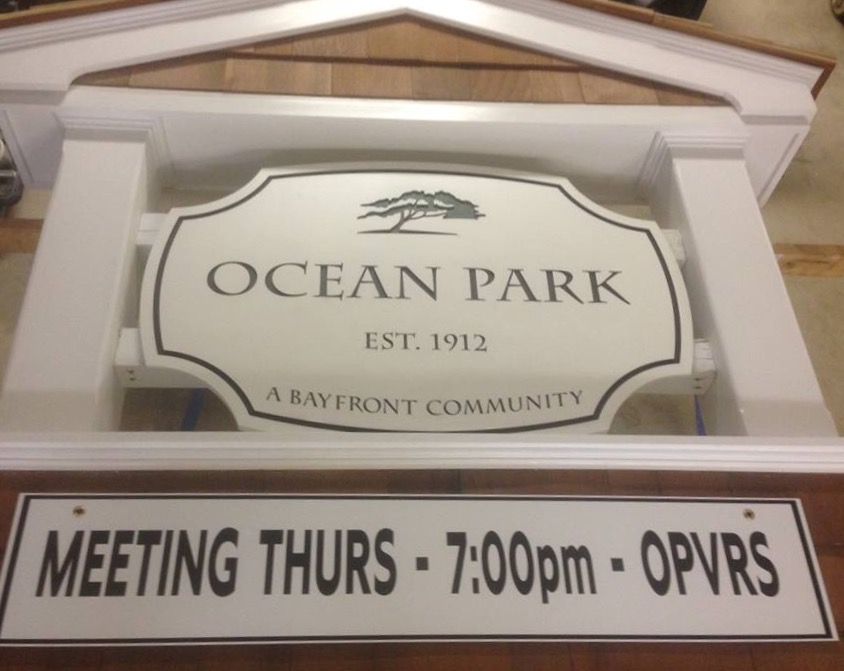
Join us 💥tonight Thursday, June 5th at OPVRS🚑 or also on ZOOM! ( NOT at Brock.. see you at the Rescue Squad!🚑)

The June 5th Ocean Park Civic League General Meeting will be held at the Ocean Park Volunteer Rescue Squad on Shore Drive at 7:00 pm. The agenda includes updates from Councilman Joash Schulman and on other ongoing issues and civic league activities.

Zoom link for Thursday’s meeting.

Resolution to Expand the Pleasure House Point Natural Area

Whereas the Pleasure House Point area provides a durable and resilient natural separation between Crab Creek and the developed areas of Ocean Park. Virginia Beach is at risk from more frequent recurring flooding due to the effects of sea level rise. While the City is evaluating flood mitigating infrastructure projects that could actively reduce the risk of flooding in Ocean Park, Ocean Park’s current flood risk can be best maintained by continuing to preserve the Pleasure House Point Natural Area. Pleasure House Point Natural Area is a vital environmental asset and community resource for the city of Virginia Beach. Environmentally, its expansive tidal wetlands contribute to the biodiversity and health of the ecosystem by providing habitat for numerous birds, fish, and other wildlife, including species of conservation concern. These wetlands naturally filter pollutants, improving water quality in the Lynnhaven River and the Chesapeake Bay watersheds. It offers natural flood protection by absorbing stormwater and tidal surges, which is crucial in safeguarding nearby neighborhoods and infrastructure from stormwater flooding and sea level rise, thereby protecting the community. For visitors and residents, Pleasure House Point offers substantial open space and canopy trees, allowing for a variety of recreational opportunities, including nature observation, fishing, and birdwatching. Privately held properties adjacent to Pleasure House Point Natural Area are essential for protecting its ecological value and public benefits.

Now, therefore, be it resolved that the Ocean Park Civic League encourages city, state, and federal agencies to prioritize the voluntary conservation of properties adjacent to Pleasure House Point Natural Area. Supports efforts by conservation groups and philanthropists to acquire land or secure conservation easements through incentives and partnerships. Invites property owners to consider voluntary conservation agreements, such as easements or restoration projects, while fully respecting their development rights. Recommends using tax incentives and grant programs to make conservation attractive and feasible. 

Pleasure House Point Wetland Mitigation Project

More information from the City of Virginia Beach about the PHP Wetlands Mitigation Project:

Video of the December 19 Wetlands Project Presentation and Question/ Answer at the Bayfront Advisory Commission Meeting. https://www.youtube.com/watch?v=x5VR6P7-2do

The Virginia Beach City Council heard a briefing on the Pleasure House Point Wetland Mitigation Bank project: City Council Presentation video November 26, 2024.

From Councilman Schulman:

“We’ve heard from many residents who have questions and concerns about the Pleasure House Point Wetlands Mitigation Bank project. Here are some things to know:

Community input is critical to the success of a project like this. Neighbors, area civic leagues, and local environmental organizations like Lynnhaven River Now, Chesapeake Bay Foundation, Friends of Live Oaks, Wetlands Watch, and our VBCPS Environmental Studies Program at the Brock (both staff and students) have all been alerted and are being kept informed and actively participating in the conversation around this project. I hope you will join us for the BAC meeting. If you can’t make it, please feel free to send me any thoughts or questions to jschulman@vbgov.com.

The project involves restoring 8 acres of the 12.3 acre project area to their previous natural state as wetlands. Prior to the 1970’s the project area existed in a natural condition as a partially wooded inlet with a broad expanse of wetlands. Between 1971 and 1972, the U.S. Army Corps of Engineers (as part of dredging the Lynnhaven Inlet) placed over one million cubic yards of dredge material over these wetlands.

The wetlands mitigation bank project was originally conceived in 2014 and went through 90% design and permitting in 2018 but was ultimately not completed due to a lack of funding and there was no compelling public need to justify the cost. These designs and construction plans were part of a larger comprehensive plan that was the result of much public participation.

There is now a compelling public need for the mitigation. This wetlands mitigation bank project will support the City’s critically important Flood Protection Program. The purpose of a Wetlands Mitigation Bank is to provide a way to offset wetlands losses that occur elsewhere in the same watershed, or “Hydraulic Unit Code Zone” (HUC Zone). The city, as part of its Flood Protection Program projects (like the Bow Creek Stormwater Park, Thalia Creek Tide Gate, Southern Rivers Watershed projects, and other road projects, in general) can cause impacts to wetlands. Under Federal and State law those impacts must be compensated for, to ensure no net loss of wetlands. There are no wetlands mitigation banks in our HUC Zone, and because of the public need associated with the multigenerational investments we are making in our Flood Protection Program, the need for this wetlands mitigation bank has become acute.

It’s important to note that the wetlands mitigation bank credits made available by this project are restricted for use with city/public projects only.Credits will NOT be available for private property owners or developers in connection with projects that impact wetlands on private property.

The process of converting highlands to lowlands, in this case, will involve a conversion from volunteer trees to valuable wetlands. I’ve asked that our City Arborist take an inventory of the trees in the area so we have a sense for the scope and so we can look for ways to minimize impact. Importantly, the wooded areas to the West of the project site are protected by a conservation easement.

The Pleasure House Point Natural Area (all 118 acres) will continue to be managed as a Natural Area Preserve by the City of Virginia Beach Department of Parks and Recreation. As part of the project, the city will be planting 600 trees. 336 of those trees will be Live Oaks and 129 trees will be Water Oaks. While all trees have value, Live Oaks and Water Oaks are hardwood trees with significantly more species value than Pine (which is what is mostly on-site currently).

There have been questions as to whether this plan involves a kayak launch. The project scope ONLY includes the wetlands mitigation bank, not a kayak launch. The concept of a launch needs to be more thoroughly and thoughtfully vetted, being mindful of the potential associated negative impacts of having a facility of that type on this property.”

Pleasure House Point Wetlands Mitigation Project

Lynnhaven River Now Executive Director, Karen Forget responded to questions raised by neighbors:

  1. Do you believe that this project will result in a net positive outcome for this natural area?

“Wetlands are our most threatened habitat and are critically important to the health and the marine life in the Lynnhaven River and the Chesapeake Bay. Most of our wetlands have been lost to development.  Wetlands were drained and canals dug to drain off the water to enable development of the land.
Bulkheads were installed severing the connection between the land and the water and drowning the wetlands.  Most of the remaining wetlands in the Lynnhaven are vulnerable to sea level rise either because they are unable to move upland because of development as the water levels rise or because they are part of our extensive marsh islands that are already eroding and are also vulnerable to drowning as water levels rise.
Much of Pleasure House Point was wetlands before the berm was built and it was used as a storage area for dredge material many decades ago.  Dredge material was piled on top of the wetlands creating the sandy areas that exist there today.”

2. Have you heard any reassurances that the city knows what it it doing in creating this wetland area? Is it difficult to create this kind of area?

    “This project will be permitted by the US Army Corps of Engineers and the Virginia Marine Resources Commission.  It is more complicated than simply excavating the sand, but this is restoration and is in a place where wetlands should be. Though I look forward to seeing more detailed plans than are available currently, I am confident that it will be well designed. These types of wetlands restoration have been done successfully in other places coastal Virginia.”

    3. Do you know what the “monitoring” consists of and who does it? What recourse is there if the area does not ‘take’ as a wetland’?

      “It is my understanding that City staff will do the monitoring.  Adjustments can be made if necessary to attain maximum functionality.”

      4. Is spoils dumping the only reason that the area filled in? Is there natural accumulation of sand etc from tidal activity.  Another words, will this fill in by itself? Will additional dredging be necessary? Which would disturb the habitat again?

        “It exists as it is today because the berm was built to hold in dredge material and dredge material was piled on top of the wetlands that naturally existed there.  It will not fill in again.”

        5. Does LRNow support this project?

        “LRNow is supportive of this project but is requesting the following:
           — The City Arborist or a contract arborist do an assessment of the trees that will be removed (number, approximate size, and species)
           — That the live oak at the corner of the project area be protected.
           — That the tree loss be mitigated at the same rate (1:1) as trees lost in other city projects.
           — That care be taken to move any existing diamondback terrapin nests in the construction area.
           — That a silt curtain and other devises be used to minimize any sediment entering the creek that could be detrimental to the thriving oyster population in Pleasure House Creek.

        We look forward to reviewing more detailed construction plans and offering comments if pertinent.  We also urge the City to provide a detailed construction schedule so that we can help the public be prepared for the changes that are coming and for any disruptions in the use of the property.”

        Blog at WordPress.com.

        Up ↑