This project is complicated. Pleasure House Point Nature Area is beloved. Residents are very aware of how close we came to having a huge residential development there instead of this beautiful city park and the Brock Environmental Center! On this page, we are trying to put information in one place about this project. We hope that by putting accurate information in one place for those who are looking for facts and information rather than the rhetoric found on social media, people can come to an informed opinion. In an attempt to organize this large amount of information, what follows is in several sections:
- What is this all about? .
- History behind the events of today.
- Environmental Groups: LRN, CBF, FOLO What do they say?
- Issues: the wetlands credit controversy
What is this all about?
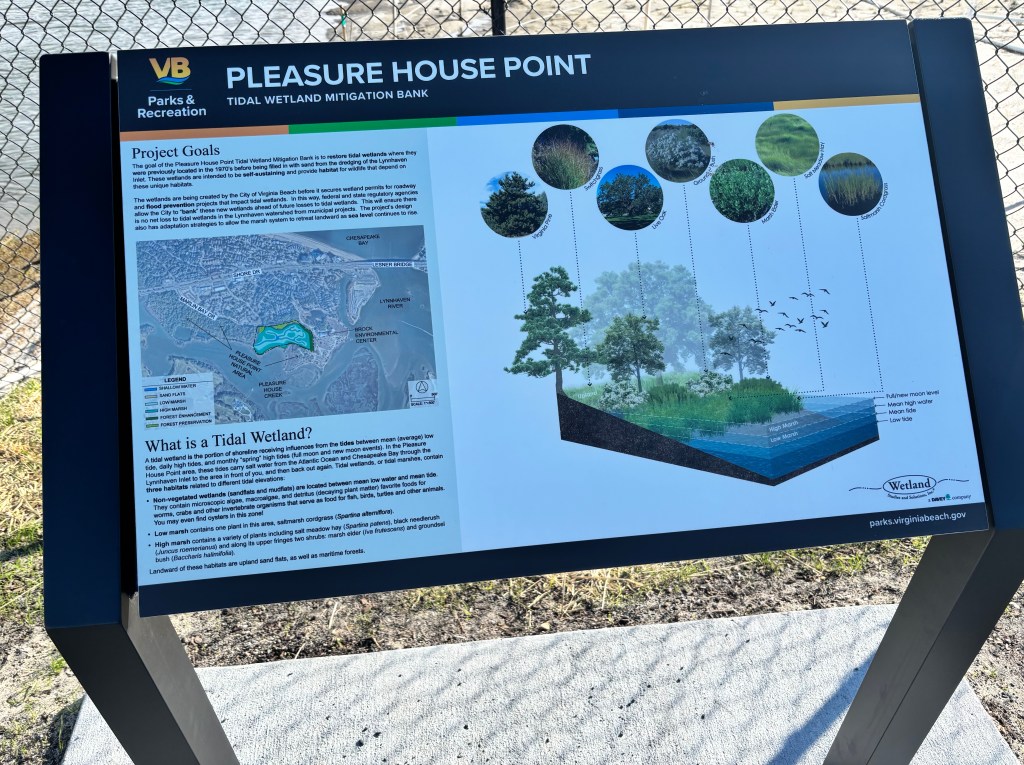
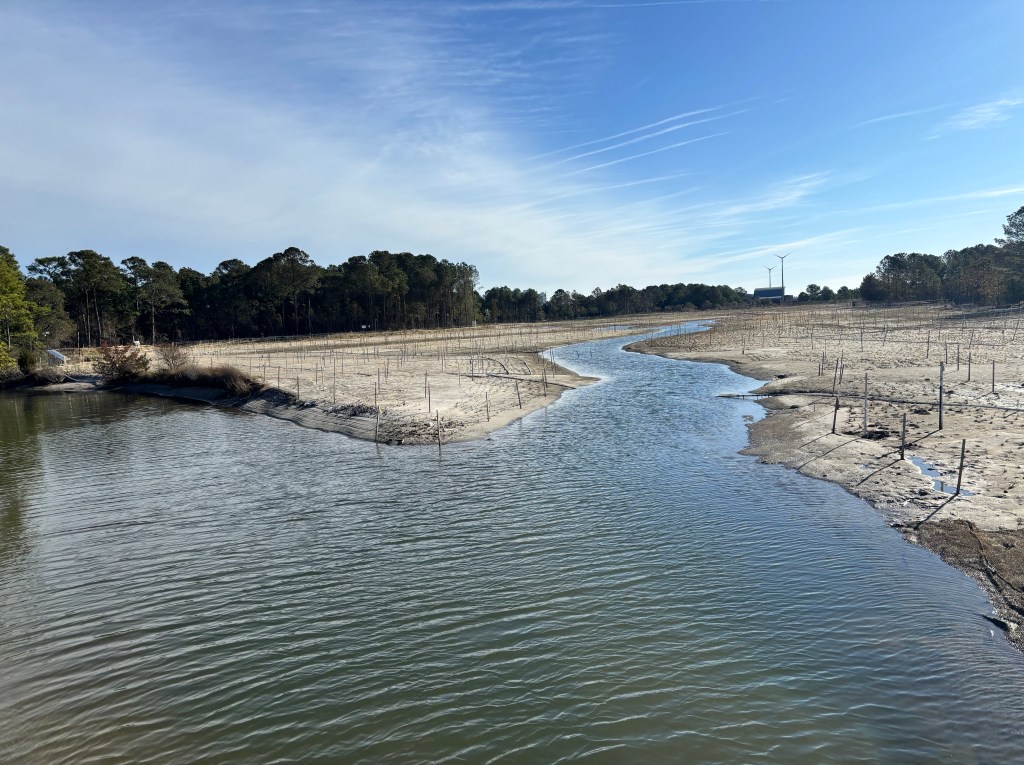
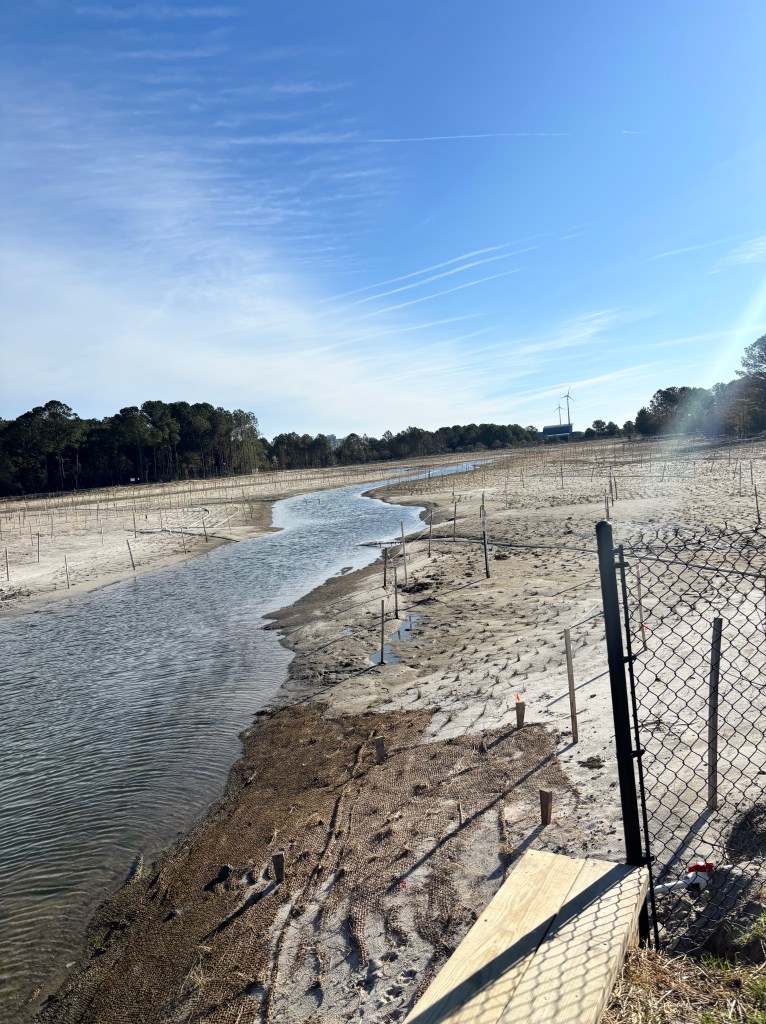
“This project involves restoring 8 acres of the 12.3 acre project area in the Pleasure House Point Natural Area to their previous natural state as wetlands. Prior to the 1970’s the project area existed as a partially wooded inlet with a broad expanse of wetlands. Between 1971 and 1972, the U.S. Army Corps of Engineers (as part of dredging the Lynnhaven Inlet) placed over one million cubic yards of dredge material over these wetlands.
The wetlands mitigation bank project was originally conceived in 2014 and went through 90% design and a permit was issued in February 2018 but was ultimately not completed and the wetlands not restored at that time due to a lack of funding and no compelling public need to justify the cost. These designs and construction plans were part of a larger comprehensive plan that was the result of much public participation.
There is now a compelling public need for the mitigation. This wetlands mitigation bank project will support the City’s Flood Protection Program. The purpose of a Wetlands Mitigation Bank is to provide a way to offset wetlands losses that occur elsewhere in the same watershed, or “Hydraulic Unit Code Zone” (HUC Zone). The city, as part of its Flood Protection Program projects will impact wetlands. Under Federal and State law those impacts must be compensated for, to ensure no net loss of wetlands. There are no wetlands mitigation banks in our HUC Zone. The city has reactivated the PHP wetlands project to provide those wetlands offset so the Stormwater projects can move forward. ” from Councilman Joash Schulman.
History
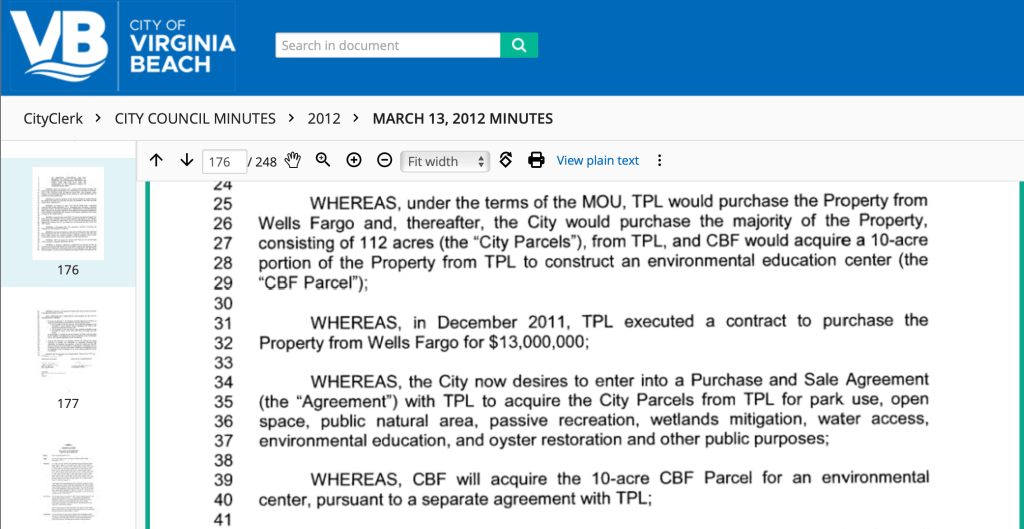
In 2012 the City of Virginia partnered with the Trust for Public Land and the Chesapeake Bay Foundation to purchase the land that is now Pleasure House Point Nature Area. The City Council Resolution of March 13, 2013 lays out the planned uses of the area to include wetland mitigation. ( Complete Document resolution starts on page 176).
In conjunction with the purchase of PHP, the Dept. of Parks and Recreation was required to submit a management plan for developing and maintaining the area. This document was prepared by Barbara Duke and her staff and contains the plans for restoration and the addition of amenities to the Pleasure House Point Natural Area. For the fiscal year beginning July 1, 2015, the Dept of Parks and Recreation has received funding from the city budget to begin design work on some of the features outlined in the plan.
November 2024 COVB Public Works presents to City Council about reactivating the plan to restore the wetlands on the PHP property. Slide presentation.
December 2024 Bayfront Advisory Commission Meeting Video of COVB Public Works Public Presentation, Friends of Live Oaks comments and Comments, Questions from the public.
January 7, 2025 City Council Approves Funding for Project . Speakers at the Jan. 7 City Council Meeting when funding was approved:
Wetlands Watch Mary Carson-Stiffstated that WW no longer opposes the project (as they did in 2014) since this is the first wetlands project to include a Sea level Rise Review from the US Army Corps of Engineers (who issues required permits) and will create a wetlands mitigation buffer.
Dr. William Duke, geologist, raised questions and concerns about the seawall/berm and sedimentation.Environmental Studies Program Coordinator
Chris Freeman related that students had ‘boots on the ground’ Tuesday morning working with the City Arborist and Public Works computer GIS support to collect data on the area: diameter, health and species of trees. In addition to Lynnhaven River Now,Chesapeake Bay Foundation,Friends of Live Oaks, and Wetlands Watch,
Jason Barney from the Green Ribbon Committee, which advises the City Council on improving water quality, also spoke in support of the project.
Princess Anne Civic League President, George Wall described the devastation that flooding has brought to the Windsor Woods area and the critical need for the flood protection projects to go forward.
LJ Hansen, Director of Public Works, explained that since the New Mills Wetlands Credits were not in the Lynnhaven HUC (see below), the US Army Corps of Engineers would almost surely not grant a waiver to use them since PHP exists as a source.10 people spoke in opposition to the project. 2 spoke in favor, 2 wanted to give information. Reasons for opposition included: need to protect endangered species and tree canopy, sharp increase in project cost from $3 to $12 million, last minute rushed timeline.
What do the Environmental Organizations Say?
Three environmental organizations have indicated their support for the wetlands project at Pleasure House Point. Each letter contains important information about their views as well as recommendations about reducing negative impacts and ensuring the project is successful.
Lynnhaven River Now works to restore Virginia Beach waterways. In addition to expressing support for the project, Executive Director Karen Forget offers ways that the organization can help mitigate the negative impact by helping transplant trees, sharing monthly water quality water monitoring results testing, relocating diamondback turtle nests, conducting public tours during construction. She also points out the importance of vigilance in use of turbidity curtains and silt fences to allay damage to the oyster beds nearby. Here is their letter to Mayor Dyer and the City Council about this project.
Chesapeake Bay Foundation met with the COVB team last week. Here are comments to interested community members which include the history of the site and suggestions for ensuring the success of the project. “This project is an opportunity to return a portion of the site to its former condition while ensuring that wetland impacts in the Lynnhaven River watershed for City of Virginia Beach flood control projects are also mitigated in the same watershed basin.” They offer suggestions for “reducing impacts to existing valuable natural resources”. Comments and questions can be directed to Christy Everett at the CBF.
PHPWMB Cheseapeake Bay Foundation Ocean Park Comments 1.6.25Download
Friends of Live Oaks is a volunteer organization dedicated to preserving live oaks. “FOLO will provide education and information about the unique environmental and ecological benefits of coastal maritime forest ecosystem communities with a focus on live oaks as well as the planting and care of live oaks.” In their letter to Mayor Dyer and the City Council, they include their view and recommendations. “Friends of Live Oaks is in support of the conceptual Management Plan and Master Plan that was completed in 2013-2014 and City adherence to its implementation.” In their letter they include very detailed recommendations for mitigating the impact on the trees in PHP.
Issues
The main issue revolves around whether the city could buy wetland credits from an existing wetlands bank rather than reactivate the PHP wetlands project. Many feel that the city can purchase credits as they had hoped to do and should not undertake the wetlands project since so much tree and habitat growth has taken place since 2018 when the project was halted. Councilman Schulman responds to comments from the community on this issue:
Comment 1: Credits exist from three banks servicing the Lynnhaven Watershed (02080108), why doesn’t the city purchase them from these banks instead of building the PHP Bank?
Answer 1: We are aware of these banks but only one has tidal wetland credits, and those tidal wetland credits have only become available recently. The existing non-tidal and tidal banks are as follows:
- New Mill Creek Tidal Mitigation Bank – has 5.27 credits of various types relating to tidal wetlands
- Chesapeake Bay Wetland Mitigation Bank – has no (0.00 tidal wetland credits for sale), and has 3.9 credits of non-tidal wetland credits.
- Virginia Aquatic Resources Trust Fund (VARTF) – has no (0.00 tidal wetland credits for sale). They have various sites, but all are for non-tidal wetland credits.
Comment 2: The City has the opportunity to purchase credits right now, from banks servicing the Lynnhaven watershed (02080108) per the USACE. The City has purchased credits from New Mill last year.
Answer 2: As noted above there is only one bank with tidal wetland credits and that bank has 5.27 tidal wetland credits to serve the Elizabeth River watershed, lower James River watershed and the Elizabeth River Watersheds. (The credits are needed in the Lynnhaven Watershed).The City has not only the needs of the Windsor Woods Pump Station and the London Bridge Creek flood gates and pump station projects (approximately 2.7 credits) to mitigate in the future, but other City projects that will have a need for tidal wetland credits as well. Even if the City could somehow purchase all the credits from that bank, it may not satisfy all the City’s future need for credits. Additionally, purchasing credits well in advance of the formal permit application process is counter to the federal regulations.
Specifically, credits are not to be purchased before the proper permit applications are submitted, reviewed by the necessary federal and state agencies and those same agencies verify that impacts to tidal wetlands are minimized to the maximum extent practicable, and only then can discussions about credits be discussed in detail. The only exception is unless the applicant owns its own mitigation facility. By the City owning its own mitigation bank, it is sure that those credits are 1) available when needed in the future and 2) will be accepted by the agencies when the time comes that they are needed. Otherwise, the City is now not even at the point to discuss use of the New Mill Creek Tidal Mitigation Bank with the Federal and State permitting agencies.
While the New Mill Creek Tidal Mitigation Bank has credits available, that does not mean that the City can automatically rely on their availability in the future when needed. Additionally, there is a second set of decisions that must be made by federal and state regulators, and which can only be made at the time of permitting; namely, whether a bank with credits to sell is the appropriate mitigation for a project, and that project’s watershed. The problem the City of Virginia Beach has is that the City has a very large project (Windsor Woods, Princess Anne Plaze & The Lakes Flood Protection Project (Megabundle Project), with large projected impacts to tidal wetlands within the Lynnhaven River Watershed. That permit application has not been submitted yet, and will be decided on by federal and state agencies about 1.5+/- years from now. The City cannot risk finding out 1.5+/- years from now that the agencies disallow use of the New Mill Bank , which could occur because it is not in the Lynnhaven River basin. The risk is that while the credits are coming from the Elizabeth River watershed, there would still be a large net loss of wetlands in the Lynnhaven River Basin. If the agencies were to decide that is not appropriate, they would notify the City that the City needs to proceed with constructing the PHP Bank as it is located in the Lynnhaven River watershed and thus would offset the impacts occurring in the Lynnhaven River Watershed.
The agencies know the City owns the PHP Bank, and has secured all the City, Federal and State agency signatures needed on the Banking Agreement. If the City were to wait 1.5 years and learn then they needed the PHP Bank, it would cause enormous delays to the schedule of the Megabundle Project, risk another flood event to those communities, and cause substantial monetary impacts to the Contractor and the City. It was too great a risk to the City and the flood protection project and is why City Council voted unanimously on January 7 to fully fund the PHP Bank.
Additionally, the agencies do not want cities or any persons to acquire wetland credits in advance of the formal permit application process for the reasons noted above. Those regulatory agencies are the arbiters of when purchasing or using mitigation credits is appropriate, and that cannot be decided until approximately 1.5+/- years from now for the Megabundle. It is simply too much of a risk to wait that long to find out the answer when the City has a fully approved mitigation banking agreement in place for the Pleasure House Point Bank. This same situation will repeat itself in the future for each subsequent City project impacting tidal wetlands in the Lynnhaven watershed.
 Ocean Park Civic League