“We’ve heard from many residents who have questions and concerns about the Pleasure House Point Wetlands Mitigation Bank project. Here are some things to know:
Community input is critical to the success of a project like this. Neighbors, area civic leagues, and local environmental organizations like Lynnhaven River Now, Chesapeake Bay Foundation, Friends of Live Oaks, Wetlands Watch, and our VBCPS Environmental Studies Program at the Brock (both staff and students) have all been alerted and are being kept informed and actively participating in the conversation around this project. I hope you will join us for the BAC meeting. If you can’t make it, please feel free to send me any thoughts or questions to jschulman@vbgov.com.
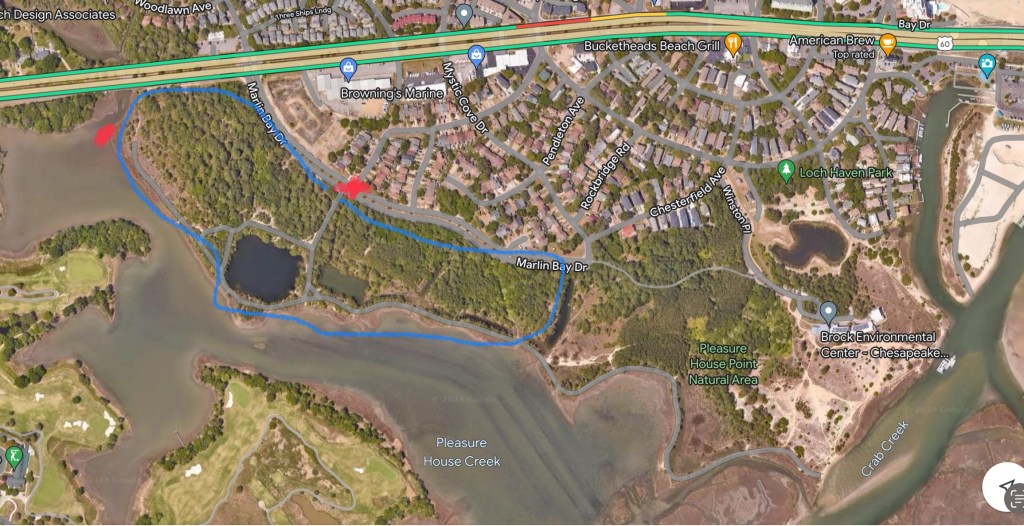
The project involves restoring 8 acres of the 12.3 acre project area to their previous natural state as wetlands. Prior to the 1970’s the project area existed in a natural condition as a partially wooded inlet with a broad expanse of wetlands. Between 1971 and 1972, the U.S. Army Corps of Engineers (as part of dredging the Lynnhaven Inlet) placed over one million cubic yards of dredge material over these wetlands.
The wetlands mitigation bank project was originally conceived in 2014 and went through 90% design and permitting in 2018 but was ultimately not completed due to a lack of funding and there was no compelling public need to justify the cost. These designs and construction plans were part of a larger comprehensive plan that was the result of much public participation.
There is now a compelling public need for the mitigation. This wetlands mitigation bank project will support the City’s critically important Flood Protection Program. The purpose of a Wetlands Mitigation Bank is to provide a way to offset wetlands losses that occur elsewhere in the same watershed, or “Hydraulic Unit Code Zone” (HUC Zone). The city, as part of its Flood Protection Program projects (like the Bow Creek Stormwater Park, Thalia Creek Tide Gate, Southern Rivers Watershed projects, and other road projects, in general) can cause impacts to wetlands. Under Federal and State law those impacts must be compensated for, to ensure no net loss of wetlands. There are no wetlands mitigation banks in our HUC Zone, and because of the public need associated with the multigenerational investments we are making in our Flood Protection Program, the need for this wetlands mitigation bank has become acute.
It’s important to note that the wetlands mitigation bank credits made available by this project are restricted for use with city/public projects only.Credits will NOT be available for private property owners or developers in connection with projects that impact wetlands on private property.
The process of converting highlands to lowlands, in this case, will involve a conversion from volunteer trees to valuable wetlands. I’ve asked that our City Arborist take an inventory of the trees in the area so we have a sense for the scope and so we can look for ways to minimize impact. Importantly, the wooded areas to the West of the project site are protected by a conservation easement.
The Pleasure House Point Natural Area (all 118 acres) will continue to be managed as a Natural Area Preserve by the City of Virginia Beach Department of Parks and Recreation. As part of the project, the city will be planting 600 trees. 336 of those trees will be Live Oaks and 129 trees will be Water Oaks. While all trees have value, Live Oaks and Water Oaks are hardwood trees with significantly more species value than Pine (which is what is mostly on-site currently).
There have been questions as to whether this plan involves a kayak launch. The project scope ONLY includes the wetlands mitigation bank, not a kayak launch. The concept of a launch needs to be more thoroughly and thoughtfully vetted, being mindful of the potential associated negative impacts of having a facility of that type on this property.”










 Ocean Park Civic League